
Start with a game that works without crypto
A blockchain does not make a game fun. Before any contract is written, the core loop has to work on its own: what players do in a match, why they play another, and what they are competing for.
That is why we keep game logic and wallet logic separate. The multiplayer backend and the game can be built and tested without crypto, and the on-chain layer is added on top. It also means your game can launch with or without on-chain features, and you can change that decision later without rebuilding the game.
Decide what actually goes on-chain
Putting everything on-chain is slow and expensive for players. Most games only need a few things there: ownership of items or NFTs, wagers and escrow, and payouts. Everything else, such as movement, scoring and matchmaking, runs faster and cheaper on your own servers.
Write down, for each feature, whether it needs to be on-chain and why. That one list shapes your contracts, your backend and your timeline more than any other decision.
The parts every blockchain game needs
- A real-time backend: rooms, matchmaking and scoring that stay in sync for every player, usually Node.js with WebSocket servers, plus Redis and PostgreSQL where needed.
- Smart contracts: Solidity contracts for wagers, payouts, minting or royalties, built on existing standards such as ERC-721 and ERC-1155 where they fit.
- Wallet connection: MetaMask or another wallet, with clear messages when a transaction is pending, rejected or fails.
- Payouts: automated, logged and tied to the result the server recorded, so nobody waits for a manual transfer.
- Admin tools: a dashboard for balances, matches and payouts, so your team can answer support questions without a developer.
- Deployment and monitoring: servers deployed with Docker so they are easy to watch, restart and update after launch.
Plan for disconnects and edge cases
When money is at stake, every edge case becomes a support ticket. What happens when a player closes the tab mid-match? When a transaction is still pending as the match ends? When both players claim they won?
These rules should be designed before the build starts, not discovered after launch. For CashPong we added a forfeit mode and automated payouts, so a disconnect ends the match fairly and the winner is paid without manual review.
Wallet flows are where players give up
Many players drop off at the first wallet prompt. Every signature request should be expected, explained in plain words and recoverable when it fails.
CashPong came to us with MetaMask transaction issues. Fixing those flows was the first of three milestones, before any new features were added, because nothing else matters if deposits and wagers do not go through.
Test contracts before mainnet
Contracts are hard to change once they are deployed, so they are tested on test networks first, including the failure cases: rejected transactions, wrong amounts and repeated calls.
For high-value contracts we recommend an independent security audit by a specialist firm, and we work with the auditor you choose. Budget time for that review in your plan.
How the CashPong build ran
CashPong is a real-time, two-player wager game on Polygon. The client came to us with a game that had wallet bugs, and we took it to full deployment in three milestones: fixing the MetaMask transaction issues, adding rooms, real-time scoring, automated payouts, a forfeit mode for disconnects and UI polish, then deploying the contract, setting up the server and launching the website.
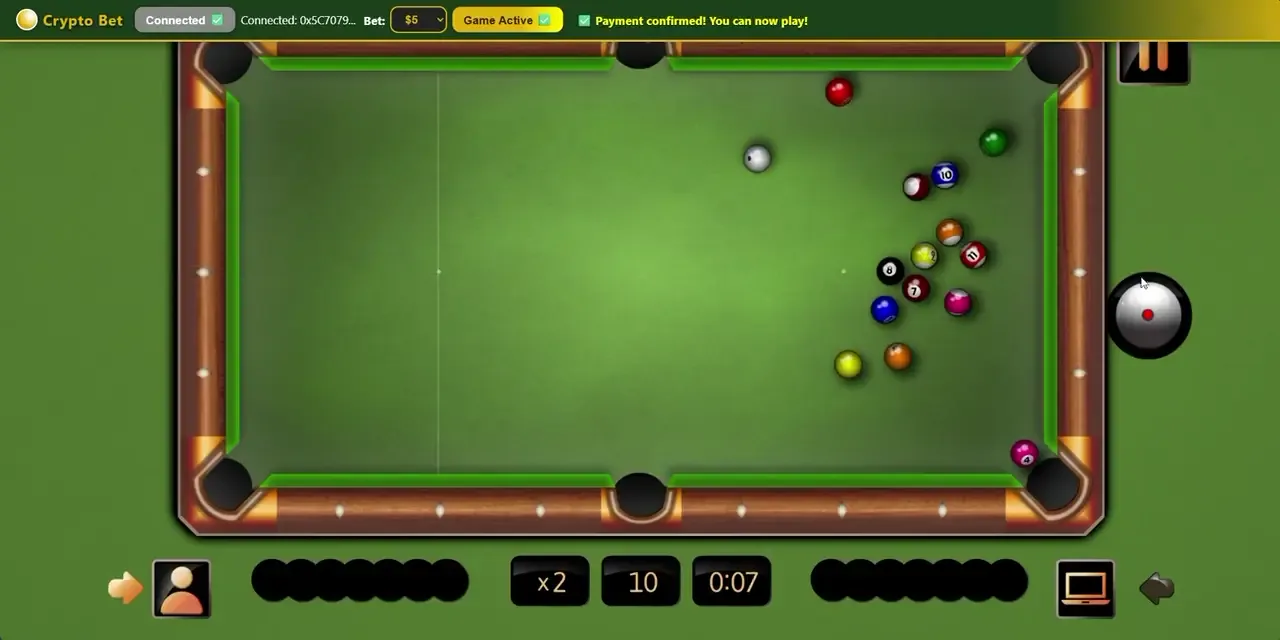
The stack was React, Node.js, WebSocket, Firebase, Solidity and Polygon. The game is live at cashpong.io. Our other Web3 work includes PepuStars, a 500-item NFT collection with minting and royalty contracts and card battles, and a multiplayer 8-ball pool game with tournaments, wallet balances and an admin dashboard.
How to choose a Web3 game development company
- Ask for live products you can open, not only contract addresses or pitch decks.
- Ask how they keep game logic separate from wallet logic, and how they handle disconnects with money at stake.
- Ask which chains and standards they have deployed to. Our delivered work includes Polygon and EVM contracts, and crypto payout integration on SUI.
- Ask how contracts are tested, and whether they will work with an independent auditor.
- Check working hours. Our day in Morocco overlaps with the US morning, so feedback sent at the start of your day is usually answered the same day.
- Agree that you receive the game, backend and contract source code.
How we work
We read your brief, ask the questions that shape scope, then split the build into milestones. Each milestone has a deliverable and its own price, and you play and approve it before the next one starts. At the end you own the code: the game, the backend and the contracts, deployed to your servers and networks, with fixes after launch.
Questions buyers ask
Can you fix or finish an existing Web3 game?
Yes. CashPong came to us with wallet transaction bugs. We fixed them, added multiplayer features and automated payouts, deployed the contract and launched the game.
Which blockchains do you work with?
Our delivered work includes Polygon and EVM contracts, and crypto payout integration on SUI. Tell us your chain in the brief and we will confirm fit before quoting.
Do you audit smart contracts?
We test every contract before deployment. For an independent security audit we recommend a specialist audit firm, and we work with the auditor you choose.
Do I need crypto in the game at launch?
No. Because the game and the wallet layer are separate, you can launch without on-chain features and add them later, or the other way around.